
The year of Dalekmania
Berwick release a far inferior version of a Dalek playsuit.


Several Dalek inspired jigsaws.


Just one of at least 6 different types of ‘anti-Dalek’ toy guns. Bit of a cash-in!

I like the boxes though. 😀

Dalek pottery!


Dalek wallpaper.

The 1965 reprint of the first Dalek story novelisation.

And following the previous year’s Dalek Book:


The first Dalek comic strips appear in TV Century 21.


Just a small selection of other Dalek merchandise that appeared in 1965.


Meanwhile, their 3rd story appeared on TV that year……
The Chase (22/5/65 – 26/65)
The Chase is an odd story in some respects. It kind of feels a bit like Terry Nation re-doing Keys of Marinus with Daleks in it, as their are are several separate mini-stories over the 6 episodes; some with a much less serious tone than anything in the first two Dalek stories.
For me, Ep 1 is the certainly the weakest opener to date. Not only is there an instant reveal which gives away the protagonists straight away, rendering the ambiguous title somewhat ineffective; it also spends half the first episode faffing around with the Time Visualiser, meaning that it’s well towards the end of the episode before it feels like anything has really happened. The Ep 1 cliffhanger is a slant on the same idea used in DIOE, but this time the Dalek gradually becomes visible out the sands of Aridius, rather than the river Thames of 22nd century London.
Things start to get rolling a little bit more in Ep 2, where the plotline around the Aridians is played out. It’s fairly standard stuff, but at least things feel like they’re moving a bit. Visually, some of the shots don’t looks bad, but the movement of the Daleks across the sand dunes is pretty poorly realised. A mistake which would be repeated again several years later in Destiny of the Daleks.
After escaping Aridius, things start to go downhill pretty quickly in a number of ways. I’m not sure if the scientist Dalek’s working out his maths aloud was intentionally or unintentionally funny, but it doesn’t work for me. Then there’s the long winded ‘comedy’ scene atop the Empire State building, which is something I fast forward through every time, as it’s so painfully unfunny. After this comes the Marie Celeste scene, which is also poorly realised, particularly the empty Dalek casing falling off the ship giving a little shriek as it does so. Unintentional comedy f’sure. And if that’s not bad enough, there’s the rather tedious House of Horrors segment, which culminates in a Dalek being picked up and chucked around by a Frankenstein’s Monster prop. Superior beings of the universe, my arse…..
Luckily, Ep 4 sets up quite a nice idea for the following episode with the android version of the Doctor, which is played out during Ep 5 after the travellers land on the planet Mechanus. Admittedly, this segment is still a little bit long-winded, but it’s the first episode I’ve found reasonably enjoyable since Ep 2.
It’s not a bad cliffhanger where we see the rather cumbersome Mechanoids for the first time, but it leads into the final and most enjoyable episode of the serial for me. Ok, some aspects of it are still a bit weak, partly due to budget restraints. Most notably the Mechanoid city, which is nowhere near as effective as the Dalek city in The Dead Planet, but the intention is there and I find that it triggers my imagination well enough to suspend disbelief.
Similarly, the Dalek/Mechanoid battle leaves a bit to be desired. The Daleks are pretty still pretty funny here when one of them gets ‘destroyed’, screeching out ‘AM EXTERMINATED!!’ before a rather feeble destruction ensues. And then there’s the one which ‘gripped’ by the Mechanoid; ‘TOTALLY IMOBILISED!!!’, which always makes me laugh out loud. 😆
Also, I’m not sure why Richard Martin thought that having a howling wind effect would somehow aid the illusion of a big battle; aided as it was by a few little animated flashes. A fellow poster recently alluded to a sort of ’60s Batman style, and I can see where he’s coming from.  In spite of its weaknesses though, I always find this last episode easy to enjoy. 😀
Then of course there’s Ian and Barbara’s departure, which is nicely handled, including a subtle yet profound little moment from Hartnell.
The Daleks themselves were an improvement in two respects; particularly with DIOE in mind. The final piece of permanent design was added, in the form of the slats, or solar panels; replacing the little satellite dishes of DIOE, which looked a bit naff. And thankfully, they sorted out that Ring Modulator setting and got the voices right, after they sounded so feeble in DIOE.
It has to be said though, that The Chase is a disappointingly weak offering, overall. It has some good things, but overall I can’t give any more than 5/10.
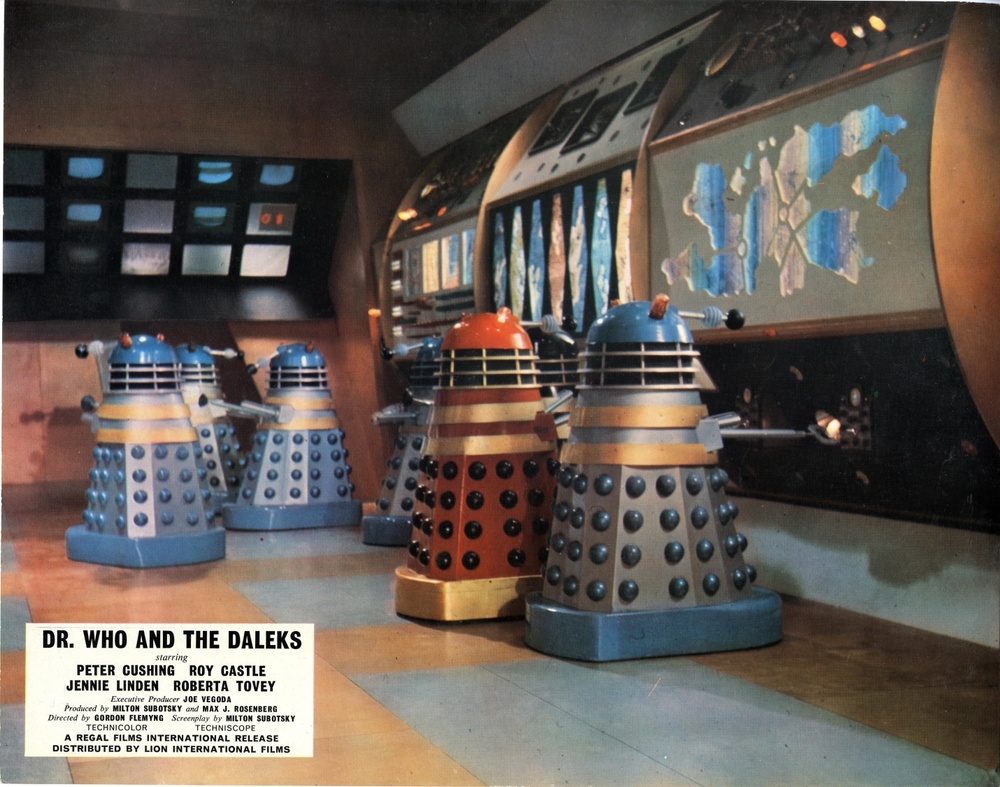
Dr Who and the Daleks (25/6/65)
In the year of ‘Dalekmania’, The popularity of the Daleks eventuated in a big screen adaptation of their first TV story, released in cinemas the day before the last episode of The Chase was broadcast on tv.
This adaptation has several key differences to the original TV version, most notably in the fact that ‘Doctor Who’ was characterised, not as an alien wanderer in the fourth dimension in a stolen Tardis, but as human inventor who had created his own ‘Tardis’ by means of his own ingenuity. Peter Cushing played the role very differently to Hartnell’s original; with character being portrayed as a kindly, if somewhat scatty, grandfather/professor, somewhat similar in some respects to Joseph Cavor’s character, played by Lionel Jeffries in the 1960 film adaptation of H.G. Well’s: First Men in the Moon. Cushing also played an even more similar role in 1976, as Dr. Abner Perry in At the Earth’s Core.
The Daleks are quite fun, and it’s great to see them looking so colourful. The Thals look good too, and are well portrayed. The Daleks underwent a bit of a makeover for the films; they had much larger fenders, making them taller, and larger lights, along with a mechanical claw replacing the suction cup. Although the suckers were still seen on some Daleks. The voices were somewhat louder, with added reverb, and they were more staccato and robotic than the tv voices.
The tone of the film is lighter, which much of the comedy relief being provided by Roy Castle. The story is condensed down from 7 episodes to 82 minutes for the film; and with a considerably bigger budget, the Dalek city, and the landscape of Skaro looked fairly impressive; and there’s a distinct ‘alien-ness’ to the petrified jungle.
For me personally, it’s enjoyable enough as an adventure romp, but it doesn’t compare to the original tv version. Although I admire Cushing as an actor in his many varied roles over the years; I’ve never been particularly keen on his ‘Doctor Who’ character. But worse than that; the bumbling Roy Castle is just cheesy to the point of annoying. He really puts me off this movie adaptation.
Overall, I’d give this film 6.5/10. It’s not ‘proper’ Dr Who, but it does look good, and is not unenjoyable. Just that Roy Castle is so bloody awful more than anything. 😆
When this film was released in the USA; a comic of the story was also published, in support. This is a pretty good strip, as it goes. You can see it here:
With their popularity riding ever higher in the latter half of 1965, thanks to the very successful movie; the Daleks returned to tv screens on October 9th, for a unique one-off episode, called Mission to the Unknown. This episode did not feature the character of the Doctor at, and served as kind teaser episode for an upcoming 12 part serial entitled The Daleks Masterplan.
Mission to the Unknown showed the Daleks operating as a space power in their own right; and set scene for a conquest of the solar system, by an alliance of different galactic races, headed by the Daleks. This episode is a very well executed piece of sci-fi, and the resulting mammoth space opera is widely regarded as a great, if largely lost, classic. It spanned across the end of 1965, and in 1966, and during its run, the Daleks appeared in stage play in their own right; called Curse of the Daleks, which opened on December 21st.

Meanwhile, two after the transmission of Mission to the Unknown; a second Dalek ‘annual’ was released, on October 11th. Entitled, The Dalek World; it capitalised on the popularity of the Daleks in their own comic strips; which began with the previous year’s Dalek Book; and continued throughout 1965 and 1966, in the popular TV Century 21 comic.
You can see all the comic strips and stories from The Dalek World, here:
The Daleks’ Master Plan (13 November 1965 – 29 January 1966)
Finally got around to this mini-marathon in itself, and for the most part, it’s one of the best examples of 1960’s Who, and has a uniquely big ‘space opera’ feel.
The story is set up well by the previously mentioned ‘Mission to the Unknown’, and Ep 1 solidly embarks us on that adventure again. We’re introduced to most of the delegates, and to Kevin Stoney’s first great performance in Who, as Mavic Chen. Not to mention of course, the Space Security Service personnel, including Brian Cant as Gantry, and Nick Courtney, as Brett Vyon.
Director Douglas Camfield is a highlight of this story, and makes his mark straight away with a great upward shot of a Dalek, which kills Gantry. When the Tardis team appear; Bill Hartnell hisses the exclamation: ‘DALEKS!!’, as he the Doctor realises his greatest foes are back. 😎
We’re fortunate enough to be able to watch the second episode which continues apace, where we soon learn of the Dalek’s “ultimate weapon”, the time destructor. But the Doctor manages to steal the precious taranium core, which, as the next episode progresses, ultimately results in the Dalek’s extermination of Zephon, deeming him responsible for its loss. Through Ep 3, with the Daleks chasing the spar ship to Desperus, events unfold, unwittingly allowing entry to one of its prisoners, who emerges holding Katarina at knifepoint.
The defining moment of Ep 4 is of course, the sudden, and dramatic death of Katarina. Whilst she may not have been aboard the Tardis for long; the strength of the performances, particularly from Hartnell and Peter Purves, press home that this event has a big impact; though such is the pace of events in this story, that they are not permitted to mourn for long; as Sara Kingdom is soon introduced into the continuing intrigue into just who is a traitor or not. And by the end of the episode there’s another death, as she shoots Brett Vyon….
We’re back to full visual for Ep 5, where we get a much stronger sense of the character of Sara Kingdom; as Steven wins her round, and she reveals that Brett Vyon was her brother. Meanwhile, Kevin Stoney is getting a chance to expand in the role of Mavic Chen, as the characters’ machinations are further revealed. But as the Daleks catch up the chase on the planet Mira; the surrounded Doctor and co, concede that “the Daleks have won!”
The plot thickens further throughout Ep 6 as they escape the Daleks, and the Doctor manages to replicate the taranium core; which Chen and the Daleks are fooled into accepting by the end of the episode.
After 6 great episodes, it’s here that the story first falters, as we are landed with a Christmas episode that devolves into a farce which is completely irrelevant to the story so far. Hearing it the first time was enough for me; and I’ve never included it in any subsequent revisits to this story. Including this one; which allows me to proceed straight to Episode 8. 😀 During which we see Chen growing ever more arrogant and delusional, whilst the Daleks pick up the chase after the Tardis again, this time in one of their own time machines. Meanwhile, the Meddling Monk has appeared.
This is where things start to lose the tension somewhat over episodes 9 and 10. For me, it’s starts to become a bit of a runaround. Actually, more meandering around than anything, and it doesn’t help that I’m not particularly keen on comedic (apparently) characters like the Monk. However, it’s certainly not all bad; and we do have the advantage of seeing Ep 10 as it was meant to be seen.
For me, the tension; starts to notch up again by Ep 11, where the rest of the delegates start to turn against Chen; although he himself is ahead of the game, (or thinks he is) faking his own death at the expense of the delegates, and capturing Sara and Steven; who he marches at gunpoint, back to the Daleks.
Ep 12 is one of the best single episodes in the DW canon. For me, possibly the best single episode of the entire 1960s. Chen by this point has completely lost the plot, and is exterminated by The Daleks. Meanwhile, the Doctor re-emerges and activates the time destructor; setting in motion a hugely dramatic climax to the this epic story; which culminates in the ageing to death of Sara Kingdom amid the chaos caused by the time destructor. From the first time I heard it, The Doctor’s broken-voiced howl; ‘GEEETTT BAAACK!!’, amid the screeching winds of destruction, made the hairs on the back of my neck stand up. Fantastic performances from hugely underrated pairing of Hartnell and Purvis, as they lament the death and destruction and particularly the recent loss of Sara. Quite wonderful stuff.
All told, despite some weaknesses, DMP is rightly hailed as one of the great classics of the era. Marred only by the fact that so much of remains missing. For the Daleks, it kept them at the forefront of Dr Who, and as ”Dalekmania’ faded gradually through 1966 and ’67, it wasn’t all over yet for the pepperpots, in the wide universe of Dr Who.
DMP gets 8.5/10 for me.
 Wayne's random blog